10 Ways to Reduce Snoring Naturally at Home: What Really Helps?
Author: RVLNSV PRASAD
Updated On: October 2026
Evidence reviewed: Clinical guidance, systematic reviews, and research available through October 2026
About Us
Author Bio
Editorial Policy
Contact Us
Introduction
Snoring can turn an ordinary night into a frustrating experience. You may fall asleep comfortably, only to hear the next morning that your breathing was loud enough to wake someone else. Sometimes, you wake up with a dry mouth or feel tired despite spending enough hours in bed.
If you are searching for ways to reduce snoring, the good news is that several practical changes may help. Sleeping on your side, avoiding alcohol near bedtime, addressing a blocked nose, and improving sleep habits are reasonable places to begin. However, the best approach depends on why you snore.
Not every snore has the same cause. For one person, the problem may appear mainly when sleeping on the back. Another may snore more during allergy season, while someone else may have an underlying breathing disorder that requires medical treatment.
This distinction matters because home remedies are not equally effective for everyone. A warm shower may ease temporary nasal stuffiness, but it cannot reliably treat an airway that repeatedly collapses during sleep.
The Mayo Clinic’s guidance on snoring identifies several lifestyle measures that may help, including side sleeping, weight management when appropriate, avoiding alcohol near bedtime, and addressing nasal obstruction.
This guide goes beyond a typical list of remedies. You will learn what to try tonight, how to recognize your snoring pattern, which popular remedies have limited evidence, and when to seek help for possible obstructive sleep apnea.
The goal is not to promise silent sleep overnight. It is to help you make informed, realistic changes without overlooking a potentially important health problem.
Quick Answer: How Can You Reduce Snoring Tonight?
If you want to reduce snoring tonight, start with the measures most relevant to your situation:
- Sleep on your side rather than your back, particularly if snoring is worse when lying face-up.
- Avoid alcohol during the hours before bedtime.
- Address nasal congestion with appropriate measures, such as saline spray or a nasal strip when nasal blockage contributes to the problem.
- Keep a consistent sleep schedule and allow enough time for sleep.
- Raise the head of your bed slightly if it improves comfort and breathing, without bending your neck awkwardly.
- Avoid smoking and seek support to quit if you smoke.
These steps may reduce ordinary snoring, but they do not guarantee immediate results.
Important: Loud snoring accompanied by breathing pauses, gasping, choking, or excessive daytime sleepiness may indicate obstructive sleep apnea. According to the National Heart, Lung, and Blood Institute (NHLBI), these symptoms deserve medical evaluation rather than reliance on home remedies alone.
Key Takeaways
- Snoring happens when tissues in the upper airway vibrate as air passes through a narrowed space during sleep.
- Side sleeping is a practical first step for people whose snoring becomes worse on their backs.
- Nasal treatments are most useful when nasal obstruction is contributing to snoring.
- Weight management, reducing alcohol intake, and quitting smoking may help some people, although results vary.
- Specialized mouth and tongue exercises have emerging evidence, but ordinary deep breathing should not be presented as a proven snoring treatment.
- A quieter night does not necessarily mean sleep apnea has been treated.
- The most useful approach is to identify your likely snoring trigger and match it with an appropriate response.
Why Do People Snore? Understanding the Real Causes
Snoring occurs when airflow causes soft tissues in the upper airway to vibrate during sleep. The soft palate, tongue, throat tissues, and nasal passages can all influence how easily air moves.
When you fall asleep, muscles supporting the airway relax. If the breathing passage becomes narrow, airflow may create the familiar rattling or vibrating sound.
The Mayo Clinic’s explanation of snoring causes identifies several contributing factors, including mouth anatomy, alcohol use, nasal problems, sleep deprivation, and sleeping position.
Common snoring patterns
| Snoring pattern | Possible contributing factor | Practical next step |
|---|---|---|
| Worse when sleeping on your back | Positional narrowing of the airway | Try side sleeping |
| Worse during a cold or allergy flare | Nasal congestion | Address the nasal blockage. |
| More noticeable after drinking alcohol | Increased relaxation of airway muscles | Avoid alcohol near bedtime. |
| Persistent snoring with weight gain | Changes affecting upper-airway anatomy | Discuss appropriate weight management. |
| Loud snoring with gasping or breathing pauses | Possible obstructive sleep apnea | Arrange medical evaluation. |
| Snoring despite trying several home remedies | Multiple causes or an untreated sleep disorder | Seek professional assessment. |
This table is a starting point, not a diagnostic tool. A person may have more than one cause of snoring, and the sound alone cannot reliably establish what is happening inside the airway.
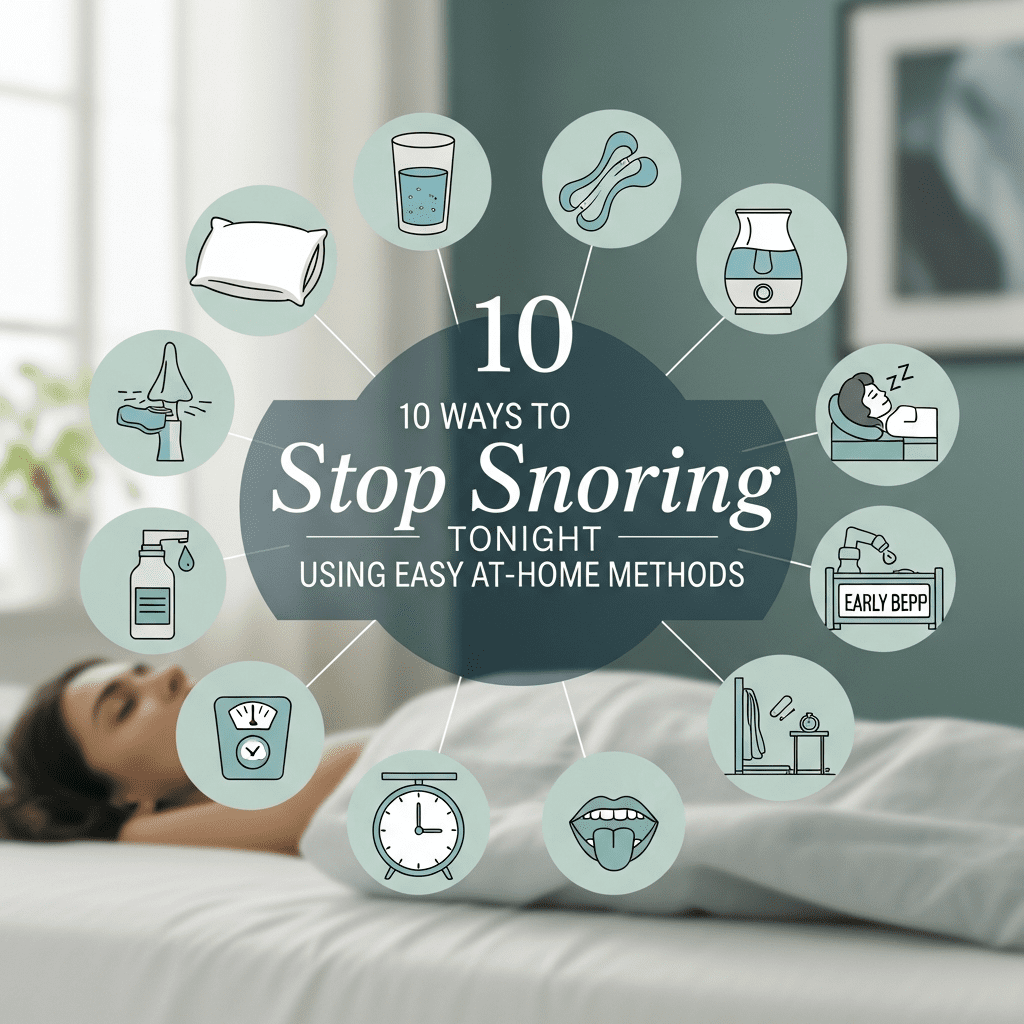
10 Evidence-Based Ways to Reduce Snoring Naturally at Home
The following methods combine established lifestyle advice with practical steps that can fit into everyday life. Some may help immediately, while others require several weeks or longer.
1. Sleep on Your Side Instead of Your Back
Changing your sleeping position is one of the simplest ways to reduce snoring when the problem is positional.
When you lie on your back, gravity can allow the tongue and surrounding tissues to move toward the back of the throat. This may narrow the airway and increase vibration.
Side sleeping may reduce that narrowing in some people.
The Mayo Clinic recommends side sleeping as a lifestyle measure for snoring. Positional approaches are also used in selected patients with positional obstructive sleep apnea, although they are not suitable substitutes for prescribed treatment in every case.
Try this tonight: Place a comfortable pillow behind your back to make rolling onto your back less likely. A body pillow may also help you maintain a side-sleeping position without feeling restricted.
If you have shoulder or hip pain, adjust the pillow arrangement so that your spine remains comfortable.
Practical insight: Ask your sleeping partner whether the snoring is noticeably different when you sleep on your side. A consistent position-related pattern is more informative than assuming every noisy night has the same cause.
2. Raise Your Head Comfortably
A slightly elevated upper body may help some people who experience snoring, especially when their sleeping position contributes to airway narrowing.
However, using several pillows under only the head can bend the neck forward and create discomfort. It may also make the sleeping position less stable.
A wedge pillow or an adjustable bed that supports the upper torso may be more comfortable than stacking ordinary pillows.
Try this tonight: If you already have a supportive wedge pillow, experiment with gentle elevation while keeping your neck in a neutral position.
Stop if the position causes neck pain, worsens breathing, or interferes with sleep.
Evidence note: Research on head-of-bed elevation is less established than guidance on side sleeping. Treat elevation as a comfort-based experiment rather than a guaranteed snoring treatment.
3. Clear Nasal Congestion Before Bed
A blocked nose can make breathing uncomfortable and may contribute to snoring, particularly when allergies, a cold, or structural nasal problems are involved.
If nasal blockage is your main trigger, addressing it may improve nighttime breathing.
The Mayo Clinic’s snoring treatment guidance discusses nasal treatments, including nasal strips and approaches to nasal obstruction.
Try this tonight: Consider a saline nasal spray or a gentle saline rinse if congestion is present. If you use a nasal irrigation device, use distilled, sterile, or previously boiled and cooled water rather than untreated tap water, as recommended by the U.S. Food and Drug Administration.
A warm shower may temporarily make your nose feel more comfortable, but it should not be described as a proven cure for snoring.
If allergies are frequent, ask a healthcare professional about appropriate treatment. Persistent one-sided blockage, repeated nosebleeds, or long-standing difficulty breathing through the nose should be assessed.
4. Avoid Alcohol Close to Bedtime
Alcohol can relax the muscles involved in keeping the upper airway open. This may make snoring worse and can aggravate breathing problems during sleep.
For people who already snore, avoiding alcohol near bedtime is a sensible step.
The Mayo Clinic recommends avoiding alcohol before bedtime as part of snoring management.
Try this tonight: Skip alcohol during the evening and compare how you sleep with nights when alcohol was consumed.
If you take sedatives, sleeping tablets, or other medicines that affect breathing or alertness, review them with your prescriber. Never stop a prescribed medication abruptly simply because you suspect it affects snoring.
Practical insight: Snoring that becomes much louder after alcohol is a useful observation to share with a clinician, particularly if breathing pauses have also been noticed.
5. Maintain a Healthy Weight When Appropriate
Body weight can influence snoring because fat distribution around the neck and upper airway may affect breathing during sleep.
However, not everyone who snores is higher weight, and losing weight is not an appropriate recommendation for every person.
For people who have excess weight and weight-related snoring, gradual weight management may help. The NHLBI’s overview of sleep apnea treatment includes healthy lifestyle changes, such as weight management, as part of care when appropriate.
Start with manageable habits: Choose regular meals, increase physical activity according to your ability, and aim for a sustainable eating pattern rather than a restrictive crash diet.
Weight changes usually take time, so this is not an overnight remedy.
A person with suspected sleep apnea should not postpone assessment while trying to lose weight. Sleep apnea can occur at many body sizes and may require treatment regardless of weight.
6. Improve Sleep Timing and Reduce Sleep Deprivation
Not getting enough sleep can influence the relaxation of throat muscles and may make snoring more noticeable.
A consistent sleep routine also supports overall sleep quality, which matters even when snoring is not completely eliminated.
The CDC’s guidance on sleep emphasizes adequate sleep and regular sleep habits as important parts of health.
Try this tonight: Choose a realistic bedtime that gives you enough opportunity to sleep. Reduce stimulating activities close to bedtime and keep your bedroom comfortable.
Most adults generally need at least seven hours of sleep, although individual needs vary.
People-first insight: Do not turn sleep improvement into another stressful task. A routine that you can maintain is more useful than a complicated schedule you abandon after two days.
7. Try Nasal Strips When Nasal Resistance Is the Problem
Adhesive nasal strips gently pull the outside of the nostrils outward, which may make nasal breathing feel easier for some people.
They are inexpensive, widely available, and relatively simple to try.
However, nasal strips do not correct narrowing deeper in the throat. They should not be relied upon to treat obstructive sleep apnea.
The Mayo Clinic notes that nasal strips may help some people breathe through the nose but are not an effective treatment for obstructive sleep apnea.
Try this tonight: If you often feel that your nostrils are narrow or blocked, follow the product instructions and see whether a nasal strip improves comfort.
Avoid applying one to irritated or damaged skin.
If your nose feels clear and the snoring comes mainly from the throat, a nasal strip may offer little benefit.
8. Quit Smoking and Reduce Exposure to Irritants
Smoking can irritate the respiratory tract and contribute to inflammation, congestion, and other breathing problems.
Quitting smoking benefits cardiovascular and respiratory health, even if the effect on snoring differs from person to person.
The CDC explains the health benefits of quitting smoking, including improvements in respiratory and cardiovascular health.
Practical starting point: Make your bedroom smoke-free and seek evidence-based support if you want to quit.
If dust, strong fragrances, or other irritants worsen your nasal symptoms, reduce exposure where practical.
Do not assume that buying an air purifier or changing your mattress will automatically stop snoring. Such changes may help particular environmental triggers, but the cause of snoring still needs to be considered.
9. Consider Specific Mouth and Tongue Exercises
Not all breathing exercises are the same.
Ordinary slow breathing can be relaxing, but it has not been established as a reliable way to stop snoring. By contrast, some research has examined targeted exercises involving the tongue, soft palate, and throat muscles.
These are sometimes called oropharyngeal or myofunctional exercises.
A Cochrane review of myofunctional therapy for obstructive sleep apnea found that these exercises may improve certain outcomes, including subjective sleepiness and sleep quality, in some adults. However, evidence limitations remain, and the exercises should not be presented as a replacement for established sleep apnea treatment.
What can you do? Ask a qualified sleep clinician or appropriately trained therapist whether targeted exercises are suitable for your situation.
A typical program may involve controlled tongue placement, tongue movement, or soft-palate exercises performed consistently over weeks.
Important distinction: This is a longer-term approach. A few minutes of deep breathing tonight should not be expected to eliminate snoring.
10. Get a Professional Assessment When Home Changes Are Not Enough
Seeking professional help is not a failure of natural treatment. It is often the most effective next step when snoring is persistent, disruptive, or associated with other symptoms.
A clinician may examine your nose, mouth, and throat, review medications, and ask about sleep quality.
If sleep apnea is suspected, a sleep study may be recommended.
According to the NHLBI’s sleep apnea diagnosis guidance, sleep studies can help determine whether breathing is repeatedly interrupted during sleep.
Treatment depends on the diagnosis and may include positive airway pressure therapy, a professionally fitted oral appliance, positional therapy, or other approaches.
Practical insight: If several home remedies have not helped, do not keep adding more remedies indefinitely. Identifying the cause may save time, money, and unnecessary frustration.
Which Snoring Remedies Are Worth Trying First?
Many online articles present every home remedy as equally effective. A more useful approach is to distinguish reasonable first steps from treatments with uncertain evidence.
| Method | When it may be useful | Evidence and limitations | Time frame |
|---|---|---|---|
| Side sleeping | Snoring worse on the back | Commonly recommended for positional snoring | May help the same night. |
| Avoiding alcohol | Snoring worse after drinking | Established lifestyle recommendation | May help the same night. |
| Saline nasal care | Temporary nasal congestion | May ease congestion; snoring benefit varies. | Short term |
| Nasal strips | Narrow or resistant nasal passages | May improve nasal airflow; do not treat sleep apnea. | Same night for some |
| Gentle upper-body elevation | Position-related discomfort or snoring | Limited evidence; comfort matters. | May I help immediately? |
| Weight management | Excess weight contributes to airwanarrowing.ng | Benefits vary and develop gradually | Weeks to months |
| Targeted mouth exercises | Selected people following professional advice | Promising but limited evidence | Usually weeks |
| Warm tea or warm water | Throat comfort or hydration | Not established as a snoring treatment | Comfort only |
| Humidifier | Dry indoor air causes discomfort. | May improve comfort; not a proven snoring cure | Varies |
| Medical assessment | Persistent or concerning snoring | Helps identify underlying causes and appropriate treatment | As soon as needed |
A Different Approach: Find Your Snoring Trigger Before Choosing a Remedy
Instead of trying ten remedies at once, use a simple trigger-based approach.
This is especially useful for people who have already spent money on sprays, pillows, or devices without knowing why they snore.
The Three-Night Snoring Pattern Check
Night 1: Observe your usual pattern. Keep your normal routine and note whether you slept on your back, had a blocked nose, or consumed alcohol.
Night 2: Focus on sleeping position. Try a comfortable side-sleeping arrangement without making several other major changes.
Night 3: Address a clear nasal trigger. If congestion is present, use appropriate nasal care and record whether breathing feels easier.
Ask your partner for feedback when appropriate, or record brief observations without obsessively monitoring every sound.
This is not a scientific experiment or diagnostic test. Night-to-night variation can occur for many reasons, and three nights are not enough to rule out sleep apnea.
Do not use this trial to delay medical care if you have breathing pauses, gasping, significant daytime sleepiness, or other concerning symptoms.
The purpose is to help you notice practical patterns rather than chase every popular remedy.
A Seven-Day Snoring Improvement Plan
If your symptoms are uncomplicated and you have no warning signs of sleep apnea, this simple plan can help you organize lifestyle changes.
| Day | Action | What to observe |
|---|---|---|
| 1 | Record your usual sleeping position and symptoms. | Is snoring worse on your back? |
| 2 | Arrange pillows for comfortable side sleeping. | Does the position stay comfortable? |
| 3 | Address nasal congestion if present. | Is nasal breathing easier? |
| 4 | Review alcohol and evening medication use. | Are there identifiable triggers? |
| 5 | Set a consistent sleep and wake time. | Do you feel more rested? |
| 6 | Reduce bedroom irritants and improve comfort. | Is congestion or irritation reduced? |
| 7 | Review your observations. | Is professional assessment needed? |
You do not need to wait seven days to contact a clinician if symptoms are concerning.
The purpose of this plan is to make changes manageable, not to suggest that snoring must improve within a week.
What Does Recent Research Say About Snoring Treatments?
Research increasingly emphasizes matching treatment to the underlying cause rather than relying on one universal remedy.
Positional therapy: Helpful for selected patients
Some people have positional obstructive sleep apnea, meaning breathing disturbances are substantially worse in certain sleeping positions, often when lying on the back.
A Cochrane systematic review of positional therapy found that positional approaches may improve measures of sleep apnea compared with no positional treatment. However, continuous positive airway pressure (CPAP) generally provides greater improvement in breathing-event measures.
This distinction is important. Side sleeping may be useful, but a quieter sleeping position is not proof that all breathing disturbances have disappeared.
Mouth and tongue exercises: Promising, but not a quick cure
Researchers have investigated whether repeated exercises targeting upper-airway muscles can improve snoring and some sleep apnea outcomes.
The Cochrane review of myofunctional therapy reports possible benefits for selected outcomes while emphasizing uncertainty in the evidence.
For readers, the practical message is straightforward: targeted exercises may be worth discussing with a qualified professional, but they require consistency and should not replace prescribed treatment.
Oral appliances: A treatment option beyond home remedies
Professionally fitted oral appliances can help selected adults with primary snoring or obstructive sleep apnea.
A clinical practice guideline published by the American Academy of Sleep Medicine and American Academy of Dental Sleep Medicine recommends oral appliances for adults seeking treatment for primary snoring without obstructive sleep apnea, with appropriate professional assessment and fitting.
These are different from unverified over-the-counter mouthguards. A properly selected appliance should account for dental health, jaw function, and the underlying sleep condition.
Why current research changes the advice
The important development is not that scientists have discovered one new home remedy that works for everyone. Instead, evidence supports a more individualized approach that considers airway anatomy, sleeping position, symptoms, and the possibility of sleep apnea.
For a reader, this means that the most effective first step may be surprisingly simple—or it may be a medical assessment rather than another household remedy.
Snoring vs. Sleep Apnea: Know the Difference
Snoring is a sound. Obstructive sleep apnea is a sleep-related breathing disorder involving repeated partial or complete upper-airway obstruction.
A person can snore without having sleep apnea, and not everyone with sleep apnea reports loud snoring.
The NHLBI explains sleep apnea symptoms, including breathing pauses, gasping, and daytime tiredness.
| Feature | Ordinary snoring | Possible obstructive sleep apnea |
|---|---|---|
| Snoring sound | May be occasional or frequent | Often loud, but not always |
| Breathing pauses | Not a defining feature | Maybe witnessed |
| Gasping or choking | Not typical | May occur |
| Daytime sleepiness | May be absent | Can be significant |
| Morning headaches | Not specific | May occur |
| Need for assessment | Depends on symptoms and impact | Medical evaluation is important. |
Seek medical advice promptly if someone observes repeated breathing pauses or gasping during sleep, or if you experience substantial daytime sleepiness. If you become sleepy while driving, avoid driving until the problem has been assessed and managed.
Common Mistakes That Can Make Snoring Advice Less Effective
Mistake 1: Assuming every home remedy is scientifically proven
Warm water, herbal tea, steam, and humidifiers may improve comfort under certain circumstances, but they should not be described as guaranteed treatments for snoring.
Choose remedies based on the likely cause rather than attractive online claims.
Mistake 2: Trying multiple remedies without identifying a trigger
If you change your pillow, use a nasal strip, drink herbal tea, and start exercises on the same night, it becomes difficult to know what helped.
Start with one or two appropriate changes and observe your response.
Mistake 3: Treating loud snoring as harmless
Snoring may be benign, but loud snoring with gasping, breathing pauses, or significant daytime fatigue requires evaluation.
Ignoring these signs can delay recognition of sleep apnea.
Mistake 4: Using mouth tape without medical guidance
Mouth taping is promoted online as a way to encourage nasal breathing, but it is not an established treatment for snoring or sleep apnea.
It may be particularly unsuitable when nasal breathing is impaired or a sleep-related breathing disorder is suspected.
Do not use mouth taping as a substitute for medical assessment.
Mistake 5: Expecting weight loss to work overnight
When weight management is appropriate, changes usually develop gradually. Rapid or extreme dieting is unnecessary and may be harmful.
Mistake 6: Believing that reduced snoring means sleep apnea is cured
Some interventions reduce audible snoring without fully resolving breathing disturbances.
If you have diagnosed sleep apnea, continue prescribed treatment unless your clinician advises otherwise.
Mistake 7: Buying devices before understanding the problem
An expensive pillow, mouthguard, or gadget may not address your specific cause of snoring.
Professional assessment is particularly useful when snoring is persistent or accompanied by concerning symptoms.
People-First Insight: A Quieter Night Is Not the Only Goal
People often seek help because a partner cannot sleep, they feel embarrassed, or they are tired of hearing complaints about snoring.
These concerns are understandable, but the goal should extend beyond making less noise.
You also want comfortable breathing, restorative sleep, and confidence that a serious sleep-related condition is not being overlooked.
A remedy that reduces sound but leaves you exhausted is not necessarily a successful solution.
Similarly, a partner may notice less snoring while breathing pauses continue. This is one reason symptoms and daytime functioning matter alongside nighttime noise.
A practical question to ask yourself: “Am I sleeping more comfortably and waking more refreshed, or have I only made the room quieter?”
That question can help guide your next step.
A Personal Experience Section: What Is Worth Sharing?
A genuine personal account can make a health article more relatable, particularly when it explains what a person tried, what changed, and what remained difficult.
However, personal experience should never be invented to strengthen an article’s credibility.
If you have personally dealt with snoring, you could describe your actual experience with changing sleeping position, noticing nasal congestion, or discussing the problem with a healthcare professional. Include only outcomes you genuinely observed, and avoid presenting one person’s result as proof that a remedy works for everyone.
For readers who have never discussed snoring with a partner, one useful starting point is a calm conversation about patterns rather than blame. Ask whether the sound is worse in particular positions and whether any breathing pauses have been noticed.
This type of observation can be helpful when deciding whether to try a simple adjustment or seek medical advice.
When Should You See a Doctor About Snoring?
Consider medical evaluation when snoring is frequent, unusually loud, disruptive, or persistent despite appropriate changes.
You should be especially alert to:
- Witnessed breathing pauses during sleep.
- Gasping or choking sounds at night.
- Excessive daytime sleepiness.
- Repeated morning headaches or unrefreshing sleep.
- Difficulty concentrating that may be related to poor sleep.
- High blood pressure together with symptoms suggesting sleep apnea.
A clinician may recommend a sleep study based on your symptoms and medical history.
The NHLBI describes sleep apnea diagnosis and explains the role of sleep testing.
If you are diagnosed with obstructive sleep apnea, treatments such as CPAP or a professionally fitted oral appliance may be recommended. The NHLBI treatment overview explains that treatment decisions depend on the person’s condition and needs.
Frequently Asked Questions About Ways to Reduce Snoring
1. What is the fastest way to reduce snoring tonight?
For someone whose snoring is worse when sleeping on the back, side sleeping may help immediately. Avoiding alcohol near bedtime and addressing nasal congestion may also be useful, depending on the cause. No home remedy guarantees that snoring will stop tonight.
2. Can I stop snoring naturally without medication?
Some people can reduce snoring through lifestyle and positional changes. However, persistent snoring or symptoms suggesting sleep apnea may require medical assessment and treatment.
3. Does drinking warm water before bed stop snoring?
There is no strong clinical evidence that warm water alone stops snoring. It may soothe a dry throat, but it does not reliably correct airway narrowing.
4. Is sleeping on your side better for snoring?
Side sleeping can help people with positional snoring. If snoring is caused by another factor, such as nasal obstruction or sleep apnea, changing position alone may not be enough.
5. Can a blocked nose cause snoring?
Yes. Nasal congestion can contribute to noisy breathing and snoring in some people. Addressing allergies or temporary congestion may help, although persistent snoring can involve other parts of the airway.
6. Do nasal strips really work?
Nasal strips may make nasal breathing easier for some people, especially when nasal resistance is a factor. They do not reliably treat throat-related obstruction or obstructive sleep apnea.
7. Can losing weight reduce snoring?
Weight management may help some people when excess weight contributes to upper-airway narrowing. It is not necessary or appropriate for everyone, and it does not replace treatment for diagnosed sleep apnea.
8. Are breathing exercises effective for snoring?
Ordinary deep breathing is not a proven cure. Specific tongue and throat exercises have shown possible benefits in some research, but results vary, and they generally require ongoing practice.
9. Is snoring dangerous?
Snoring itself is not always dangerous. However, it can be a symptom of obstructive sleep apnea, particularly when accompanied by gasping, breathing pauses, or excessive daytime sleepiness.
10. Can snoring disappear permanently?
Snoring may improve when a contributing factor changes, but it can return with nasal congestion, alcohol use, weight changes, or different sleeping positions. Persistent symptoms should be evaluated.
11. Should I use mouth tape to stop snoring?
Mouth taping is not an established treatment for snoring or sleep apnea. It may be unsafe or unsuitable for some people, especially those with nasal obstruction. Seek professional advice rather than using it to manage unexplained breathing problems.
12. When should I get a sleep study?
A clinician may recommend sleep testing if you have symptoms suggesting obstructive sleep apnea, including witnessed breathing pauses, gasping, or substantial daytime sleepiness.
Conclusion: Small Changes Can Help, but the Cause Matters
The most useful ways to reduce snoring are those that address the reason your airway becomes noisy during sleep.
For some people, sleeping on the side or avoiding alcohol before bedtime makes a noticeable difference. Others may benefit from treating nasal congestion, improving sleep habits, or working toward sustainable weight management when appropriate.
Yet not every snoring problem can be solved with a pillow, warm drink, or bedtime routine. Persistent loud snoring, gasping, breathing pauses, and excessive daytime tiredness deserve professional attention because they may indicate obstructive sleep apnea.
Begin with the simplest evidence-supported change that fits your symptoms. Observe what happens without expecting an overnight cure, and seek medical guidance when warning signs are present.
Better sleep is not just about reducing noise. It is about breathing comfortably, protecting your health, and waking up ready for the day.
Author Note
RVLNSV PRASAD
This article is written to help readers understand common snoring triggers, practical home measures, and the limits of self-treatment. It draws on clinical guidance and published research rather than promising that one remedy will work for everyone.
The information is educational and does not represent an individual medical examination or diagnosis. Readers are encouraged to seek qualified care for persistent symptoms or possible sleep apnea.
Read the Author Biography | Editorial Policy
Medical Disclaimer
This article is intended for general health education and is not a substitute for professional medical advice, diagnosis, or treatment.
Snoring may sometimes be associated with obstructive sleep apnea or other medical conditions. If you experience breathing pauses, gasping during sleep, excessive daytime sleepiness, or persistent symptoms, consult a qualified healthcare professional.
Do not discontinue prescribed medicines, CPAP, or other sleep apnea treatments without medical advice.
Fitness Disclaimer
General physical activity and weight management may support health and can be relevant to some people with snoring. However, exercise and dietary changes should be appropriate for your age, medical history, and physical ability.
Consult a healthcare professional before beginning a demanding exercise or weight-loss program if you have a medical condition or concerns about your health. Physical activity is not a replacement for treatment of obstructive sleep apnea.
Sources
The following sources support the medical explanations and recommendations discussed throughout this article.
- Mayo Clinic — Snoring: Symptoms and Causes. Explains airway vibration, risk factors, and common snoring triggers.
- Mayo Clinic — Snoring: Diagnosis and Treatment. Covers lifestyle measures, nasal treatments, oral appliances, and other treatment options.
- National Heart, Lung, and Blood Institute — Sleep Apnea Symptoms. Explains symptoms that may indicate sleep-related breathing problems.
- National Heart, Lung, and Blood Institute — Sleep Apnea Diagnosis. Describes clinical assessment and sleep testing.
- National Heart, Lung, and Blood Institute — Sleep Apnea Treatment. Reviews treatment approaches, including positive airway pressure therapy and lifestyle measures.
- Cochrane—Positional Therapy for Obstructive Sleep Apnea. Reviews evidence for position-based interventions.
- Cochrane—Myofunctional Therapy for Obstructive Sleep Apnea. Examines tongue and throat exercises and their limitations.
- Journal of Clinical Sleep Medicine — Oral Appliance Therapy Guideline. Clinical guidance for oral appliances in primary snoring and obstructive sleep apnea.
- Centers for Disease Control and Prevention — About Sleep. Provides recommendations on sleep duration and healthy sleep habits.
- U.S. Food and Drug Administration — Is Rinsing Your Sinuses Safe?. Explains safe water use for nasal irrigation.
- Centers for Disease Control and Prevention — Benefits of Quitting Smoking. Describes established respiratory and general health benefits of smoking cessation.
Related content
- 5 Simple Home Exercises for Hypothyroidism to Lose Weight
- Gut Health Revolution: How Nutrition Shapes Your Microbiome
- Train Smarter, Not Harder: Optimizing Workouts for Maximum Results
- The American Wellness Revolution: How to Thrive in a Fast-Paced World
- 10 Best Morning Health Propensities to Boost Your Vitality and Productivity
- 4 Holistic Approaches to Managing Chronic Pain: A Comprehensive Guide
- Integrating Holistic Wellness Into Your Daily Routine: A Comprehensive Guide to Total Well-Being
- 6 Ways to Detox Your Body Holistically: A Comprehensive Guide